 Audit et conseil en stratégie
In 2026, ARKHENUM will rebrand as MEMORIST. This name change seemed necessary given the evolution of the company and its service offerings, which now extend far beyond digitization. This new name, MEMORIST, and its promise, "Heritage & Beyond," represent a strong...
Hand over the money!
Hand over the money!
Founded in 864 by Charles II, the Monnaie de Paris – France’s official mint – is the nation’s oldest institution and one of the world’s longest-standing companies. The mint was Paris’s first factory and remains one of the few still in operation today. The Monnaie de Paris enjoys global recognition for its expertise, striking coins for 40 different countries worldwide. In 1973, the company opened a new French factory in Pessac.
The Pessac facility is responsible for manufacturing euro coins for circulation in France, as well as minting foreign currencies. It manages the entire production process, from cutting the blanks (pieces of metal that are shaped and weighed before being transformed into coins) to packaging the final product. Every year, over 1.6 billion circulating coins are minted at Pessac, with two-thirds destined for export.
© Monnaie de Paris – Hôtel de la Monnaie de Paris – The foundry circa 1900
Why is it important to preserve this heritage?
In light of the Monnaie de Paris’s mission – “To share the currencies of yesterday, to create the currencies of today and invent the currencies of tomorrow” – safeguarding its heritage has naturally become a central priority. With a collection of 300,000 objects, the institution is the guardian of priceless tangible and intangible assets.
The Monnaie’s factory at 11, Quai de Conti in the French capital hosts the Musée de la Monnaie de Paris, a mint museum dedicated to the art of metalworking. This one-of-a-kind experience combines exhibition spaces with a glimpse into some of the factory’s workshops. The exhibition route explores a wide range of disciplines (including art, science and technology, the history of peoples, taste and economics, as well as archaeology and sociology) that reflect the richness and diversity of the Monnaie de Paris’s collections and celebrate the men, women and professions that uphold its exceptional craftsmanship.
Everyone is free to explore the museum’s collections online and even visit virtual exhibitions thanks to a digital portal dedicated to the museum’s historical holdings (which are growing year after year).
This first digitisation campaign will focus on the tools used in jeton production (also known as dies) under the Ancien Régime. The primary aim of the project is clear: to showcase the museum’s holdings – and the first step in this process is to upgrade the institution’s online portal. There is a second objective: to launch a dedicated digital platform, in partnership with the BnF, that will present the tools used to manufacture jetons alongside the tokens they produced, as held in the National Library.
Contract for digitising artefacts in situ
Following the contract awarded to Arkhênum, the company is tasked with digitising the complete set of Ancien Régime jeton-making tools over a three-year period. The aim is to digitise all 4,500 objects that fall within this category.
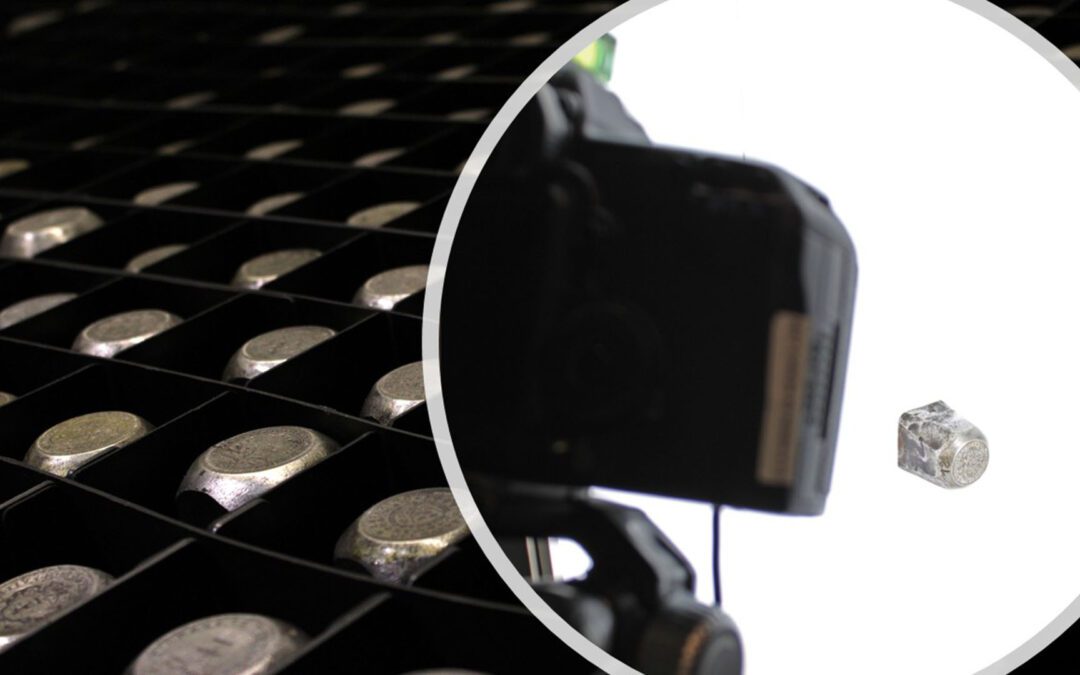
The initial phase of the project, set for 2025, will focus on digitising the first 1,500 dies, and will generate 5,000 digital views. Each tool will be photographed from three angles: axial, three-quarter and side view.
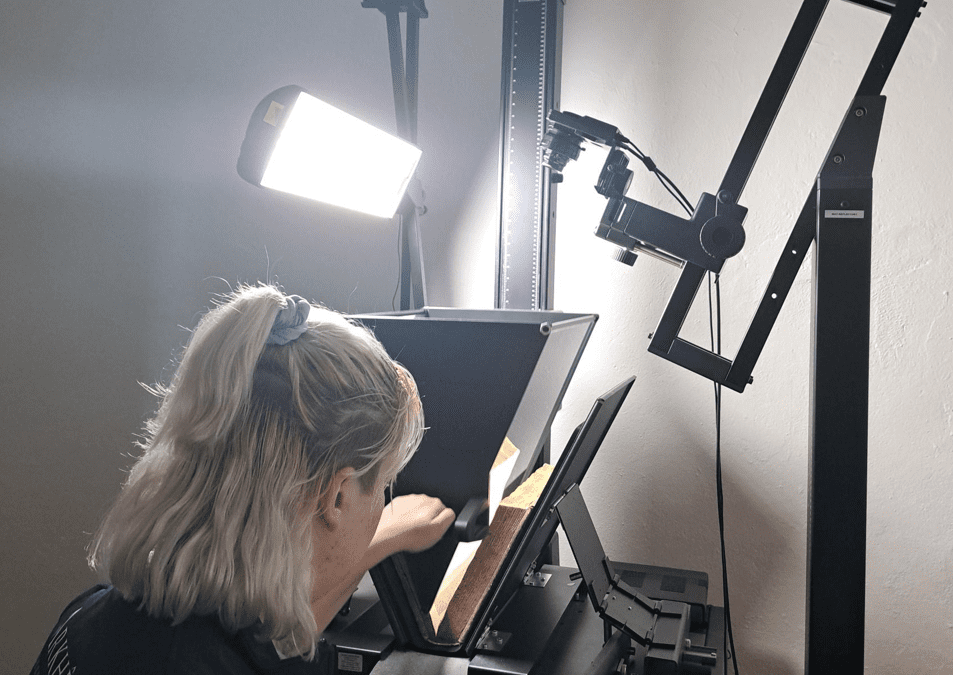
Our on-site team will set up a custom-built photographic studio on the Pessac site, which is home to the entire collection. This will consist of:
- One Phase One digital camera, which will be used to capture axial shots of the impression.
- One ScanCube scanner for 2D imaging with optimal lighting thanks to its reflective panels.
Our two photographers – Stephanie and Tom – will respect the site’s specific working conditions (designated working hours, protective footwear and safety vest, strict access protocols, etc.).
The technical hurdles
The special characteristics of these objects means that our experts will need to devise targeted solutions to address different aspects of the imaging process. They will be required to:
- Document the materiality of the objects by capturing all the details and markings, including on the secondary sides of the tooling.
- Capture axial views (of impressions), a three-quarter view, and – where necessary – an additional side view to reveal any inscriptions that are absent from the three-quarter shot.
- Factor in special cases for dies coated with varnish or grease as well as polished dies, where colorimetry or lighting will be required.
Additional refinement will also be called for during post-processing, which will take place in the Arkhênum workshops:
- Centimetre scale embedded onto the cropped image
- Embedding of the object’s inventory number
What does 2026 hold in store for us?
In 2026 and 2027, the teams at Arkhênum and the Monnaie de Paris will work closely together to digitise the entire inventory of 4,500 Ancien Régime jeton dies.
This project to digitise coining dies is a first for Arkhênum, which has traditionally focused more on digitising coins. It is an exciting challenge for our technical and R&D teams to test the limits of existing and future technologies as well as our production processes.
Do you have any unusual projects you would like to discuss with us? Click here to get in touch
SHARE THIS ARTICLE
Every page turned is an archived story
Arkhênum becomes MEMORIST
Hand over the money!
Founded in 864 by Charles II, the Monnaie de Paris – France’s official mint – is the nation’s oldest institution and one of the world’s longest-standing companies. The mint was Paris’s first factory and remains one of the few still in operation today. The Monnaie de...
Delivering state of the art heritage digitisation services worldwide
A MEMORIST company, Arkhênum has been providing digitisation and sharing services for heritage and industrial collections for over 25 years. Our services are carried out either in our own workshops or directly on site, wherever our clients may be. Watch our video to...
